
Decide — Because Not Choosing Is a Choice
Inaction has a cost

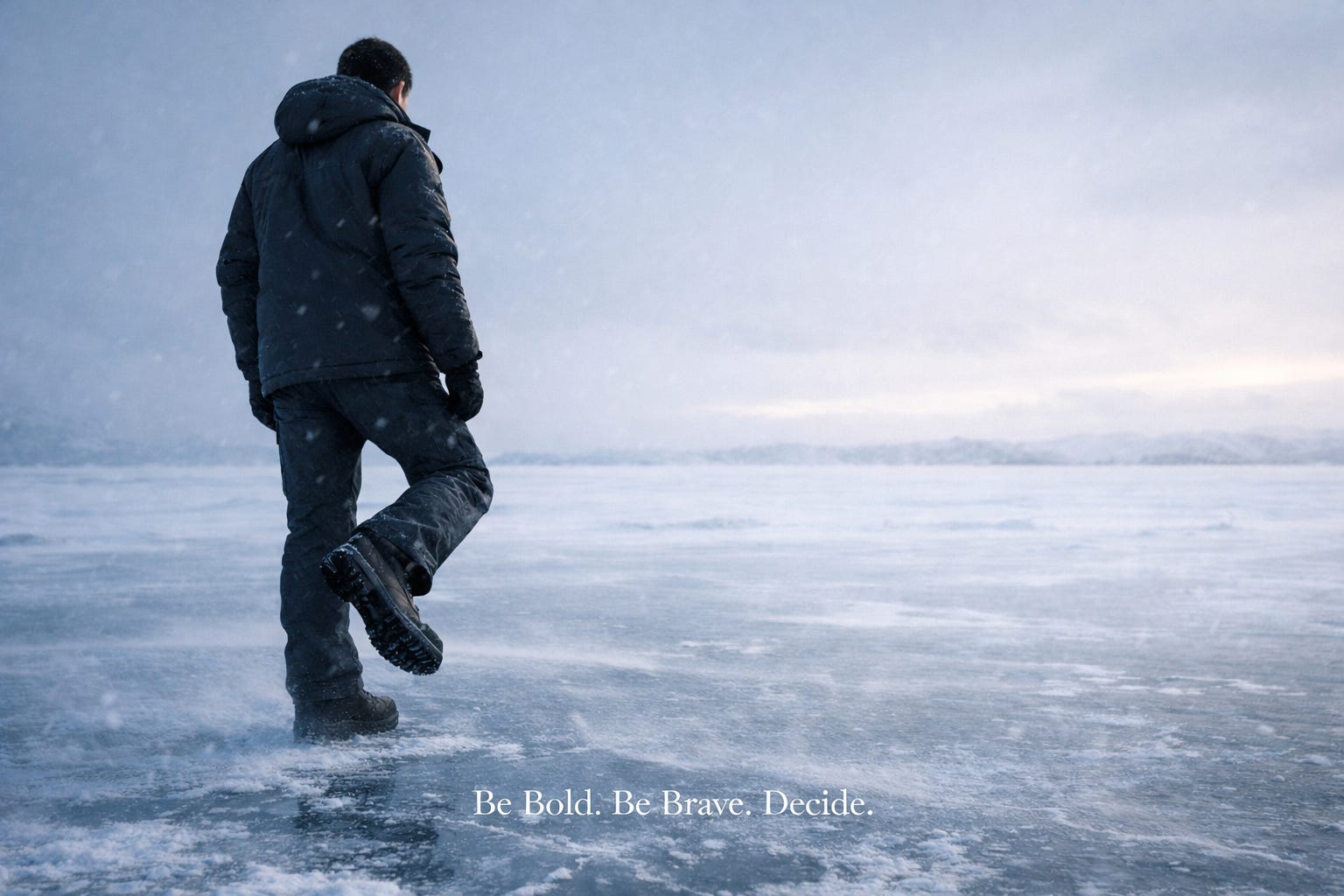
Most people think change is the risky option.
Leaving a job. Stepping away. Saying no to the life they’ve built. That’s what feels dangerous. That’s what triggers the spreadsheets, the late-night mental gymnastics, the endless “not yet” conversations.
Staying, on the other hand, feels neutral. Responsible. Safe.
But staying is not neutral.
It’s a transaction.
Whether you acknowledge it or not, you are already paying for the life you’re living. The only question is whether you ever consciously chose it — or whether you’ve been covering the cost quietly, month after month, year after year, without looking at the receipt.
That’s the part no one talks about.
The Myth of Neutral Ground
We tell ourselves we’re “just waiting.”
Waiting for the right time.
Waiting for more clarity.
Waiting for things to settle down.
But waiting is not a pause. It’s a decision by default. When you don’t choose, something else does — habit, obligation, momentum, fear. Life doesn’t stop billing you just because you haven’t signed anything recently. The payments continue, just small enough not to set off alarms. This is how people stay for decades without ever saying yes.
Not because they’re weak or unaware. But because the cost of staying is designed to be subtle. It doesn’t arrive as a crisis. It arrives as erosion. A little less energy each year. A little less curiosity. A narrowing sense of possibility that’s easy to explain away as “being realistic.”
The most expensive things in life rarely announce themselves.
The Moment I Felt It Close In
When I returned from my Camino walk — from my time away — something unexpected happened. It wasn’t disappointment. It wasn’t regret. I wasn’t depressed or dramatic. In many ways, I was grateful. Grounded. Clear. But almost immediately, I could feel the world pressing back in.
The schedules. The expectations. The familiar rhythms reasserting themselves as if they had been patiently waiting for me to come to my senses. Nothing was wrong — and that’s what made it unsettling. The pressure wasn’t new. It was familiar.
And in that familiarity, I saw something I hadn’t fully seen before: this wasn’t the cost of stepping away. This was the cost I had already been paying long before I ever left — I just hadn’t named it yet.
I realized then that the life I had returned to was not something I was actively choosing. It was something I had been agreeing to, quietly, out of habit and responsibility and momentum.
By the time I stepped away, the real bill had already been running for years.
The Quiet Costs No One Puts on the Ledger
The hidden cost of staying doesn’t look like burnout at first. It looks like “fine.” You still function. You still perform. You still show up. But slowly, the terms of the agreement change.
You pay with agency — as decisions get outsourced to calendars and obligations. You pay with attention — as your mind is always elsewhere, always managing the next thing. You pay with creativity — postponed until “someday” when there’s more room to breathe. You pay with emotional range — mistaking numbness for stability. You pay with time — not all at once, but in small, unremarkable slices that add up to years.
None of these costs feel catastrophic in isolation. That’s why they’re so easy to ignore. But together, they form a life that looks solid from the outside and quietly hollow from within.
This isn’t failure. It’s drift.
Why Staying Feels Safer Than Change
Human beings are remarkably good at adapting to slow discomfort. We can live with mild dissatisfaction for a very long time if it’s predictable. Familiar pain feels manageable. Unfamiliar freedom does not. Staying allows us to believe we’re being prudent. Responsible. Adult. It gives us language that sounds wise — “I can’t just walk away,” “I have people counting on me,” “Now’s not the right time.” And sometimes those things are true.
But often, they mask something else: a reluctance to fully acknowledge what we’re already sacrificing in order to keep everything intact. Certainty gets confused with safety. Structure gets confused with meaning. Endurance gets confused with virtue.
And so we keep paying — not because we love the life we’re living, but because we’ve learned how to survive it.
When the Math Becomes Visible
There’s a moment — usually quiet — when the math changes. Nothing explodes. No ultimatum arrives. But you see it. You realize that staying hasn’t been free. It’s just been deferred. The cost has been spread out enough to avoid attention, but the total is undeniable. You don’t panic. You don’t quit on the spot. You simply recognize the truth: you have been investing heavily in a life you never consciously chose.
That realization alone changes everything. Because once you see the transaction clearly, you can’t unknow it. You may continue for a while — but you’ll do so with awareness. And awareness restores agency, even before action.
This Is Not a Call to Leave
Let me be clear about what this is not. This is not an argument for quitting your job, ending your relationship, or burning down your life. Not every situation requires departure. Not every season calls for stepping away.
This is a call to choose.
To stop living on autopilot. To stop paying without consent. To stop confusing endurance with alignment. A chosen life doesn’t always look different on the outside — but it feels different on the inside. There’s ownership. Presence. A sense of agreement with your own days.
When you choose, even constraint becomes honest.
The Question That Lingers
You don’t need to change your life today. But you do need to know what it’s costing you. What are you paying for in energy, attention, aliveness — and when was the last time you consciously agreed to those terms?
Because the most dangerous thing isn’t change. It’s spending an entire life without ever choosing it.
Be Bold. Be Brave. Decide.
Fair Winds
Captain Rickman
The Bold Sabbatical is built on a simple three-legged stool: stepping away with intention, rediscovering who you are beneath the noise, and redesigning the next chapter of your life on your own terms.
You can move forward or backward through these essays at any time — each one is a different doorway into the same journey.